Hull
Hull is an intermediate language used by the Core Solidity compiler between SAIL and the Yul backend. Every SAIL program is lowered to Hull after type-checking, monomorphization, and match compilation. Hull is then translated to Yul for final code generation.
Hull retains algebraic data types (products and sums) from SAIL, but eliminates polymorphism, type classes, higher-order functions, and all surface syntax sugar. The result is a first-order, monomorphic language whose structure maps directly onto Yul constructs.
Note Hull is produced by the compiler and is not intended to be written by hand. The concrete syntax described in this document exists to make diagnostic
.hulloutput readable. It can be inspected by passing the-dump-hullflag to thesol-corebinary.
Relation to the Compilation Pipeline
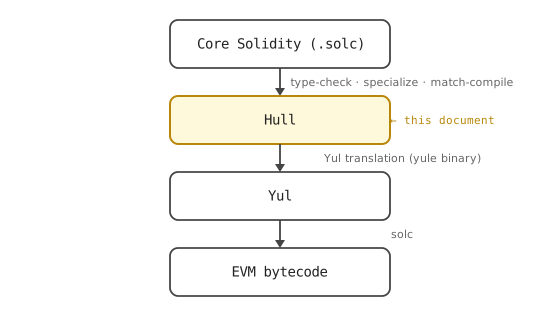
The Core Solidity performs all stages up to and including Hull emission. The
yule compiler takes Hull as input and produces Yul. Yul is then compiled to
EVM bytecode by the standard solc compiler.
Types
All types in Hull are monomorphic. Type variables are fully instantiated by the specializer before Hull is produced.
word
word is a 256-bit unsigned integer, corresponding to the native word size of
the EVM. All arithmetic values, storage addresses, and ABI-encoded data are
ultimately represented as word.
bool
bool is the Boolean type. Its only values are the literals true and false.
unit
unit is the zero-size type. Its only value is (). It carries no information
and occupies no storage. unit appears as the payload type of nullary
constructors in sum types. For example, the None branch of Option(word) has
payload type unit.
Product Types
A product type is written as:
(T1 * T2)
It holds two values simultaneously, one of type T1 and one of type T2. The
* operator is right-associative, so A * B * C is parsed as A * (B * C).
The projections fst and snd extract the left and right components of a
product value, respectively.
Note N-ary products are not yet implemented. Products with more than two components are encoded as right-nested pairs:
(A, B, C)is represented as(A * (B * C)).
Sum Types
A sum type is written as:
(T1 + T2)
It holds a value of either type T1, tagged as the left branch, or type T2,
tagged as the right branch. The + operator is right-associative, so
A + B + C is parsed as A + (B + C).
Sum values are constructed using injection expressions (inl, inr, in(k))
and deconstructed using match statements.
An n-ary sum can also be written as sum(T1, T2, ..., Tn), but the binary
right-nested encoding is what the Yul code generator uses internally.
Named Types
A named type is written as:
Name{T}
It attaches a human-readable label to an underlying structural type T. The
name is purely documentary: the Yul backend strips it and operates on the
underlying structure. Named types originate from user-defined data
declarations in Core Solidity; the specializer fills in the concrete type
arguments and wraps the result in a named type to preserve the original name in
diagnostic output.
For example, the Core Solidity declaration:
data Option(a) = None | Some(a);
when specialized at a = word produces the Hull named type:
Option{(unit + word)}
Function Types
Function types are written as:
(T1, T2, ..., Tn -> R)
Function types appear only in function definitions; they are not first-class values. Hull has no higher-order functions and no closures.
Expressions
Integer Literals
An integer literal is a non-negative decimal integer that denotes a word
value. The value must fit in 256 bits.
42
1000000
Boolean Literals
true and false are the two values of type bool.
Unit
The expression () is the single value of type unit.
Variables
A variable refers to a locally declared name. Variable names follow the same
identifier rules as Yul: they may contain letters, digits, _, and $.
Note The compiler conventionally uses names beginning with
$for compiler-generated variables, such as$altfor the payload variable introduced by amatchalternative. User-visible names do not begin with$.
Pairs
A tuple expression constructs a product value:
(e1, e2)
The type of (e1, e2) is (T1 * T2) where T1 and T2 are the types of e1
and e2. Tuples with more than two elements are right-nested: (e1, e2, e3) is
equivalent to (e1, (e2, e3)).
Projections
fst(e) evaluates to the first component of the pair e. snd(e) evaluates to
the second component.
fst(e)
snd(e)
Both e must have a product type.
Sum Injections
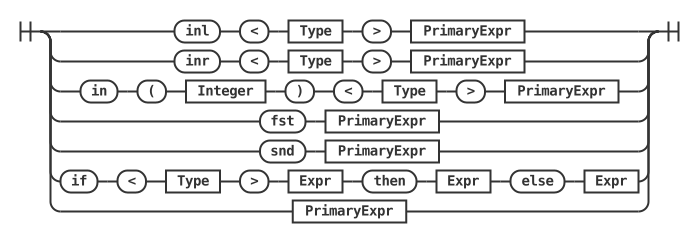
A sum injection constructs a sum value. The following three forms are available:
| Form | Meaning |
|---|---|
inl<T>(e) | Injects e as the left branch of T |
inr<T>(e) | Injects e as the right branch of T |
in(k)<T>(e) | k-th injection into the n-ary sum T |
The type annotation T is the target sum type, not the type of e. This
annotation is mandatory: the Yul code generator needs the full sum type to
compute the correct memory representation of the injected value without
re-running type inference.
For example, inr<Option{(unit + word)}>(42) injects the word 42 into the
right branch of Option{(unit + word)}, representing Some(42).
inl<Option{(unit + word)}>(()) injects () into the left branch, representing
None.
Function Calls
A function call applies a named function to a list of arguments:
f(e1, e2, ..., en)
All call targets in Hull are statically known names produced by the specializer. There is no dynamic dispatch or virtual call mechanism.
Conditional Expressions
A conditional expression selects between two alternatives based on a boolean value:
if<T> cond then e1 else e2
cond must have type bool. Both e1 and e2 must have type T. The type
annotation T is mandatory. Conditional expressions are generated by the
if-desugaring pass from Core Solidity if/else expressions.
Statements
Statements are executed sequentially inside function bodies and blocks. There are no statement separators; statements are delimited by whitespace and the structure of the enclosing block.
Variable Declaration
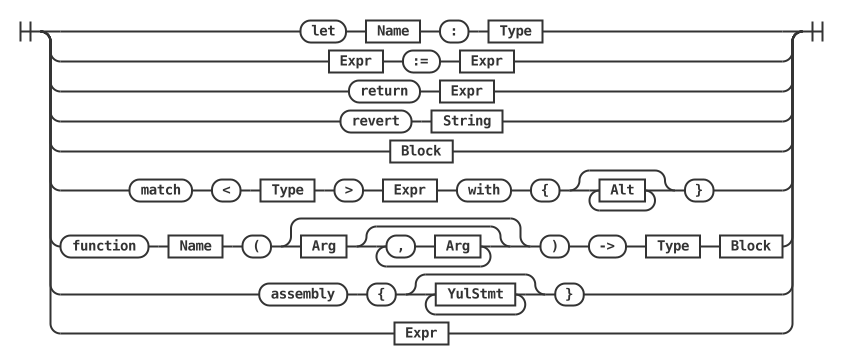
let x : T
Declares a mutable local variable x of type T. The declaration does not
initialize the variable; it must be assigned before it is read. This corresponds
directly to Yul's uninitialized let declaration.
Warning Reading a variable before it has been assigned is undefined behaviour at the Yul level. The compiler always assigns variables before reading them, but hand-written Hull must respect this invariant.
Assignment
lhs := rhs
Assigns the value of rhs to lhs. The left-hand side is most commonly a
variable name, written as x := e.
Expression Statement
A bare expression can be used as a statement:
e
The expression is evaluated for its side effects and the result is discarded.
This form is used for calls whose return type is unit.
Return
return e
Returns the value of e from the enclosing function. Every execution path in a
Hull function must end with a return or revert.
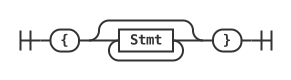
Block
{
  stmt1
  stmt2
  ...
}
A block groups a sequence of statements. Blocks are used as the bodies of
match alternatives and function definitions.
Match
match<T> e with {
  inl $alt => { ... }
  inr $alt => { ... }
}
Deconstructs the sum-typed expression e of type T. Each alternative names
the payload of its branch and executes the corresponding block. The following
constructor patterns are available:
| Pattern | Matches |
|---|---|
inl | Left injection |
inr | Right injection |
in(k) | k-th injection (n-ary) |
The type annotation <T> is mandatory. It is used by the Yul translator to
determine the memory layout of the sum type.
Note Sum types with more than two constructors are represented as right-nested binary sums. Deconstructing them requires nested
matchexpressions: the outermatchseparates the first constructor (left branch) from the remainder (right branch), and inner matches continue the decomposition.
Function Definition
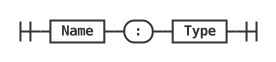
function f(x1 : T1, x2 : T2, ...) -> R {
  stmt1
  stmt2
  ...
}
Defines a named function with explicitly typed parameters and a single return type. Hull functions are translated directly to Yul functions.
The following properties hold for all Hull functions:
- Parameters and the return type must be given explicit Hull types.
- Functions are first-order: no function-typed parameters or return values.
- Each function has exactly one return type.
- The specializer produces unique names for each monomorphic instantiation, for
example
map$wordormaybe$Word.
Assembly Block
assembly {
  <Yul statements>
}
An inline assembly block embeds raw Yul statements directly in the Hull output.
The block passes through unchanged into the generated Yul. Assembly blocks are
used to access EVM primitives such as mload, mstore, add, iszero,
revert, and similar opcodes.
See the Yul documentation for the complete overview of Yul syntax.
Revert
revert "message"
Immediately aborts execution. The string literal is a diagnostic label. The
match compiler generates revert statements for branches that are unreachable
at the Core Solidity level but must be given a code path in the Hull output.
Comment
/* text */
A block comment. Comments carry no semantics and are stripped during Yul
translation. The compiler inserts comments to annotate which source-level
constructor each $alt variable corresponds to, for example:
inl $alt => { /* None */
              return n
            }
Alternatives
An alternative is a branch in a match statement:
Con $var => { body }
Con is one of inl, inr, or in(k). $var is a fresh variable name that
is bound to the payload of the matched constructor. body is a block of
statements. The bound variable has the payload type of the matched branch: for
inl and inr on a sum type (T1 + T2), the payload types are T1 and T2
respectively.
Contracts and Objects
At the top level, a Hull program consists of named objects following the Yul
object model. An object has a name, a code block containing statements, and
zero or more inner objects:
object "ContractName" {
  code {
    ...deployment code...
  }
  object "ContractName_deployed" {
    code {
      ...runtime code...
    }
  }
}
The outer object's code block is the deployment (constructor) code. The inner
object's code block is the runtime code. This structure corresponds exactly to
the Yul object notation used by solc. During Hull emission, the Core Solidity
contract body is split into these two objects automatically.
Concrete Syntax Reference
The grammar diagrams below use the railroad diagram convention: rounded boxes denote terminals (keywords and punctuation literals) and rectangular boxes denote non-terminals.
Types
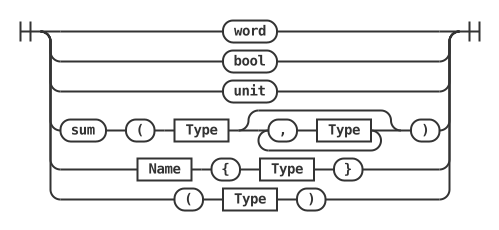
PrimaryType: the base forms that can appear in any type position:
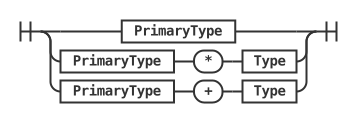
Type: combines primary types with * (product) and + (sum), both
right-associative:
Expressions
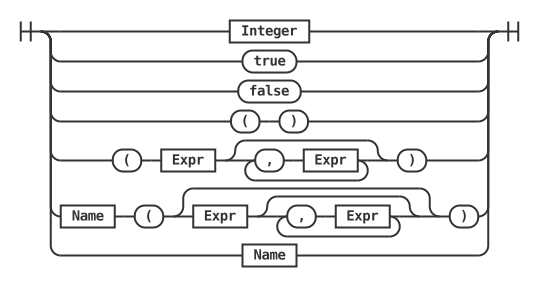
PrimaryExpr: literals, variables, tuples, and calls:
Expr: the complete expression grammar, including injections, projections, conditionals, and primary expressions:
Statements
Stmt: the complete statement grammar:
Block: a brace-enclosed sequence of statements:
Auxiliaries
Arg: a typed parameter in a function definition:
Con: a constructor tag in a match alternative:
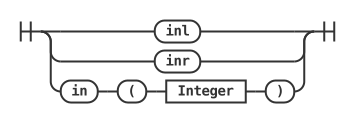
Alt: a match alternative, binding the payload to a name:

Objects
Object: a named code container, optionally containing inner objects:

Examples
The following examples show Core Solidity source programs alongside the Hull they produce. All examples are accepted by the Core Solidity prototype.
Identity Function
The simplest possible Hull function passes its argument through unchanged:
function id(x : word) -> word {
    return x;
}
Hull output:
function id (x : word) -> word {
  return x
}
Optional Value
The following Core Solidity program defines an Option type and a maybe
function that extracts the contained value or returns a default:
data Option(a) = None | Some(a);

function maybe(n : word, o : Option(word)) -> word {
    match o {
        | None    => return n;
        | Some(v) => return v;
    }
}
After specialization at a = word, the Hull output is:
function maybe$Word (n : word, o : Option{(unit + word)}) -> word {
  match<Option{(unit + word)}> o with {
    inl $alt => { /* None */
                  return n
                }
    inr $alt => { /* Some */
                  let var_1 : word
                  var_1 := $alt
                  return var_1
                }
  }
}
Note that the function is renamed from maybe to maybe$Word by the
specializer to reflect the type instantiation. The Option{(unit + word)} named
type preserves the original constructor name in the type annotation.
Enumeration Type
The following program defines a three-constructor enumeration and converts it to an integer:
data Color = Red | Green | Blue;

function fromEnum(c : Color) -> word {
    match c {
        | Red   => return 0;
        | Green => return 1;
        | Blue  => return 2;
    }
}
Hull output:
function fromEnum (c : Color{(unit + (unit + unit))}) -> word {
  match<Color{(unit + (unit + unit))}> c with {
    inl $alt => { /* Red */
                  return 0
                }
    inr $alt => match<(unit + unit)> $alt with {
                  inl $alt => { /* Green */
                                return 1
                              }
                  inr $alt => { /* Blue */
                                return 2
                              }
                }
  }
}
The three-constructor type Color is encoded as the right-nested binary sum
(unit + (unit + unit)). The outer match separates Red (left) from the
remaining constructors (right). An inner match then separates Green (left)
from Blue (right).
EVM Arithmetic via Assembly
The following contract uses an inline assembly block to invoke the add EVM
opcode:
contract Add1 {
    function main() -> word {
        let res : word;
        assembly { res := add(40, 2) }
        return res;
    }
}
Hull output:
object "Add1" {
  code {
    ...deployment code...
  }
  object "Add1_deployed" {
    code {
      function main () -> word {
        let res : word
        assembly {
          res := add(40, 2)
        }
        return res
      }
    }
  }
}
The assembly block is reproduced verbatim in the Hull output and passes
through unchanged into the generated Yul.